+441278550640
  info@proswimwear.co.uk
  UK DELIVERY OVER £35







Training for Triathlon: Swimming Tips
Master the swim leg of your triathlon with expert tips on technique, pacing, and confidence-building strategies.
Perfect Your Technique
Swimming efficiently starts with proper technique. Unlike cycling or running, where brute force can often compensate for imperfections, swimming demands a streamlined approach to reduce drag.
Focus on Body Position
Your body should be horizontal in the water, with your head aligned with your spine. Keep your legs close to the surface, as sinking legs create unnecessary drag.
Master Your Stroke
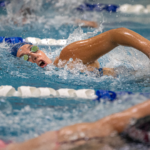
Prioritize a long, smooth freestyle stroke. Enter your hand into the water fingertips first, extend forward, and execute a high-elbow pull to maximise propulsion.
Utilise Drills
Drills like the “catch-up drill” and “fist swimming” can improve your efficiency. Dedicate a portion of your training sessions to these exercises to develop muscle memory.
Breathing Made Easy
Many triathletes struggle with breathing, especially in open water. Learning to breathe comfortably can transform your swimming experience.
Exhale Fully
A common mistake is holding your breath underwater. Instead, exhale fully and continuously, which allows you to take quick, efficient breaths when you turn your head.
Practice Bilateral Breathing
Bilateral breathing–alternating the side you breathe on–improves your symmetry and adaptability. This is particularly useful when conditions like waves or sun glare affect one side.
Tip:
Incorporate breathing exercises into warm-ups to establish a rhythm before starting your main sets.
Mastering Your Pacing
Many triathletes make the mistake of starting the swim leg too quickly, only to burn out midway. Learning how to pace yourself ensures you conserve energy for the bike and run segments.
Start Slow, Build Momentum
Begin your swim at a controlled, sustainable pace. After the initial few minutes, gradually increase your intensity if you feel comfortable.
Use a Tempo Trainer
A tempo trainer can help you maintain a consistent stroke rate. Set it to beep at intervals that match your desired cadence.
Building Open Water Confidence
The open water environment can be intimidating, even for seasoned swimmers. Familiarity and preparation are key to overcoming this challenge.
Practice in Open Water
Whenever possible, train in open water to simulate race conditions. Practice sighting by lifting your head periodically to spot buoys or landmarks.
Simulate Race Starts
Open water races often begin with a chaotic mass start. Recreate this scenario in training by swimming in a group, practicing your entry, and managing close contact.
Stay Calm
If you feel overwhelmed, slow down and focus on your breathing. A few strokes of backstroke or breaststroke can help you regain composure.