+441278550640
  info@proswimwear.co.uk
  UK DELIVERY OVER £35






The advances in smart watch technology over the past decade has led to huge strides in the standard and quality of fitness and activity trackers for runners, cyclists and swimmers.
Now, more than ever before, athletes are able to monitor and track every element of their performance.
There are endless benefits to having such detailed performance analysis available instantly, either with a glance to your wrist, or by checking out a smartphone app or laptop.
In the past, swimmers have often looked on enviously at runners and cyclists for having such an incredible array of statistics and training reports at their fingertips. But not any more.
While smart watch industry big-hitters such as Apple and Garmin have both developed their underwater technology, other specialist waterproof fitness trackers and swimming smart watches have also burst onto the market.
At ProSwimwear, we stock specialist swim trackers which are designed to help any standard of swimmer, from beginners right through to elite performance swimmers.
Here, we take a look at how the FINIS Swimsense and the Swimovate Poolmate watches can help you get the most out of your time in the water, and we answer some commonly asked questions on how to make the most of your swimming smart watch.
FINIS Swimsense swimming smart watch uses app and bluetooth technology
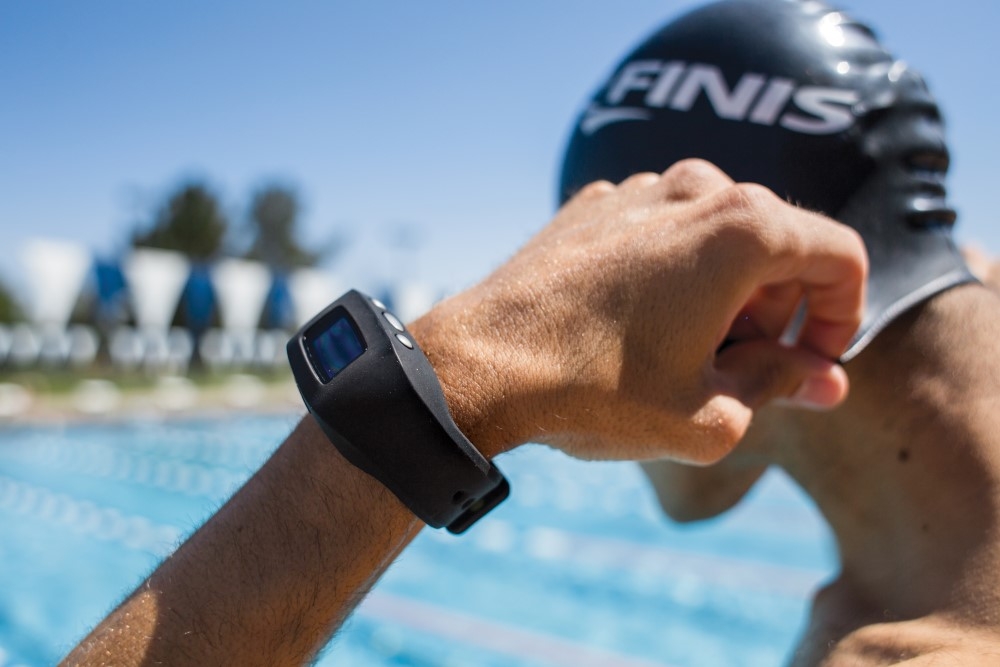
The FINIS Swimsense Live waterproof swimming watch is set up to work in conjunction with the FINIS Live app, which is available on Apple’s App Store and also Google Play.
This bluetooth-compatible watch allows you to instantly review your swim statistics on your smartphone or tablet.
It has a rechargeable battery which powers the watch for up to seven hours when fully charged, and the device can store up to 14 workouts. All summary data can be stored on the FINIS Live app.
The Swimsense provides detailed analysis on total laps, time intervals, pace, distance per stroke, calories and SWOLF.
It has built-in algorithms to identify the four main swim strokes of freestyle, butterfly, backstroke and breaststroke and will accurately record intervals and distance for each.
Custom settings also allow to set up your preferred pool distance as well as measurements, gender and weight.
The inclusion of bluetooth and the FINIS Live app sync on the Swimsense adds a whole new dimension to a swimming watch, so this really is a fantastic training aid. You can click here to read more about the FINIS Swimsense Live or watch our video below.
Swimovate Poolmate 2 swimming activity tracker now has open water setting
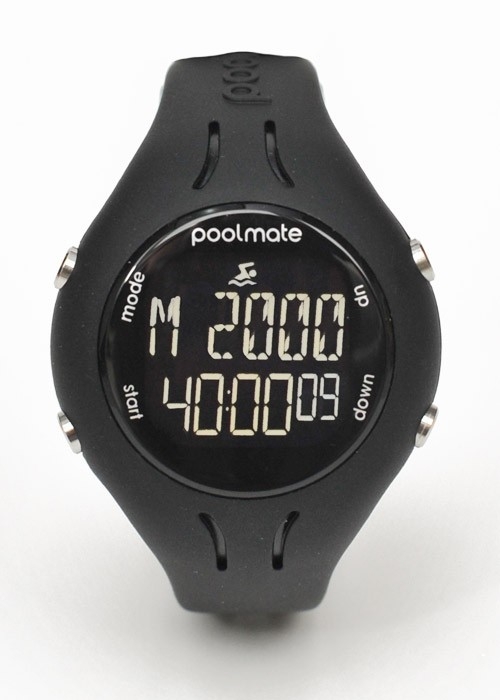
If you’re not worried about using an app or bluetooth, then the Swimovate Poolmate 2 should be your number one choice. At less than £70, the Poolmate 2 also offers exceptional value for money and will count laps, strokes, distance, speed, efficiency, duration, sets, rest time and calories. It’s a real all-rounder.
Another big feature of this watch is its open water pedometer setting. Users just need to swim a simple calibration lap to set up this open water mode, which uses the built-in accelerometer to calculate swim metrics.
It is this method, rather than GPS technology, which gives the Poolmate 2 a long battery life of around two years. These accelerometers will provide any swimmer with accurate results, as long as they have a regular stroke and take more than seven strokes per lap (on the arm that the watch is worn).
In addition to the battery life, this swimming watch also has the capacity to store more than 50 sessions as well as recording individual sets and total session data.
Click here to read more about the Swimovate Poolmate range of swimming watches. The base model is available in a choice of black, blue, purple or grey colours.
There is also the Poolmate Plus which can be plugged into a PC or Mac, or synced with an Android smart phone, and the Poolmate HR which has a built-in heart rate monitor.
When should I wear a swim tracker watch?
As often as you want! You can never have enough data from training sessions. However, many swimmers find these swimming watches most useful when they are training on their own.
Older swimmers will remember when the only way to record the number of lengths was by mentally counting, or pressing a button or clicker at the end of each length.
Swim tracker watches will do all this for you, as they’ll pick up when you’ve turned at the end of the length and will automatically update the built-in lap counter.
How can I use a swimming smart watch for motivation during training?
Again, if you’re swimming on your own, it’s easy to lose concentration or motivation.
Using a swim tracker will give you actual results at the end of your swim session, in black and white. This can then be used as a target for your next session or as part of a longer-term training strategy.
Seeing your results, and seeing that you’ve hit your targets, will give you a sense of accomplishment and will drive you to be more motivated in the water.
Why use a swimming watch when I can just check the pace clock?
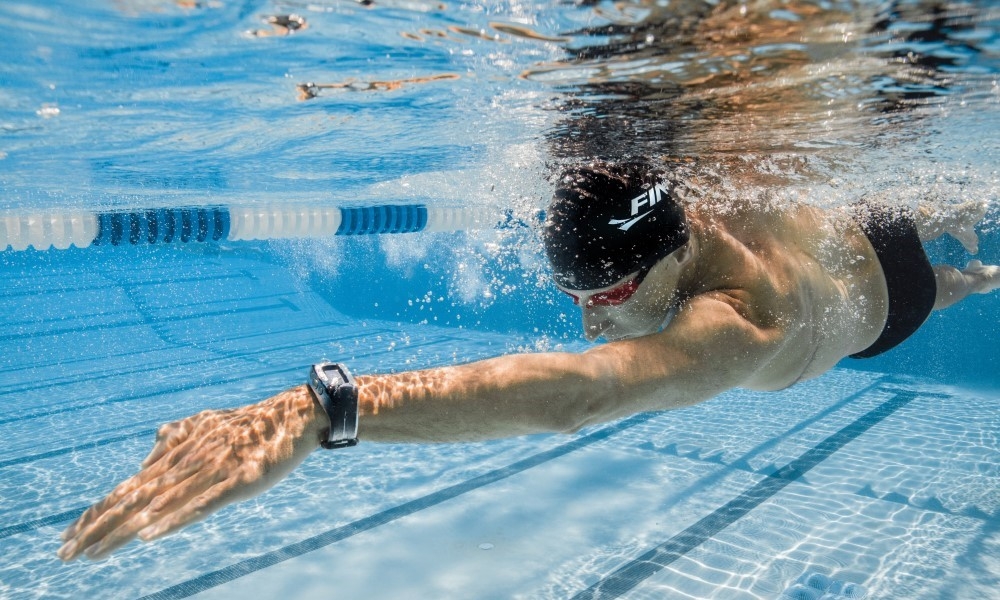
Wearing a swim watch will give you your most accurate measurements possible.
If you’re checking the clock at the swimming pool when you set off and finish, you’re open to miscalculations. You may mistakenly miscount the number of lengths you’ve swam, or you may subconsciously round up your start/finish time.
Using a swimming watch will give you consistent and accurate results, providing measurable targets and goals for you to develop an all-round fitness or training strategy.
Can I use them just as a fitness watch for swimming?
Absolutely. You don’t need to build an entire training plan around your swimming watch. These watches will provide you with a calorie count after each session, so they’re ideal for fitness swimmers who are swimming for exercise and improved health.
You’ll be able to see exactly how long you’ve been swimming for, and you can even try a few different sessions using different strokes, to analyse any difference in calorie usage.
What is a SWOLF score?
Many people assume SWOLF is an acronym. It’s not. It’s an abbreviation of the phrase ‘swim golf’ which is something swimmers have been using for years to measure their efficiency in the water.
Simply put, it’s a score calculated by adding your strokes per length and the time of the length. For example, using 20 strokes in a 30-second length would give you a SWOLF score of 50. The theory behind this score is that your swim is more efficient if you’re using fewer strokes and taking less time.